What a PIFF Is and How to Create One for Your Soaps
If you’re planning to sell handmade soap in the UK, you’ll quickly come across the term PIFF. For many new sellers, it sounds intimidating — but in reality, a Product Information File is simply a structured record of your product.
This post explains what a PIFF is, why it matters, and how to create one properly for your soaps.
What Is a PIFF?
PIFF stands for Product Information File.
It is a legally required file that contains all the information needed to demonstrate that your cosmetic product is:
- Safe
- Properly assessed
- Correctly labelled
- Traceable
A PIFF must be available before you sell a product and kept up to date for as long as the product is on the market.
Why a PIFF Is Required
In the UK, soap sold to cleanse the skin is classed as a cosmetic product. Cosmetic regulations require that every product has a PIFF so authorities can verify compliance if requested.
Your PIFF:
- Supports your safety assessment
- Protects you if issues arise
- Demonstrates professional practice
- Is a legal requirement — not optional
You don’t submit your PIFF anywhere, but you must be able to produce it if asked.
What Must Be Included in a PIFF
A PIFF is a collection of documents, not a single form. For handmade soap, it typically includes the following sections:
1️⃣ Product Description
A clear description of the product, including:
- Product name
- Product type (e.g. cold process soap)
- Intended use (cleansing the skin)
- Target user (general population, unless otherwise specified)
This helps identify exactly what the PIFF relates to.
2️⃣ Cosmetic Product Safety Report (CPSR)
This is one of the most important parts of the PIFF.
Your CPSR must be:
- Completed by a qualified safety assessor
- Specific to your formulation
- Valid for the ingredients and usage levels used
The CPSR confirms that your soap is safe when used as intended.
3️⃣ Full Ingredient Formula
This section includes:
- Complete ingredient list
- Exact percentages or weights
- INCI names for all ingredients
- Fragrance or essential oil components
This formula must match:
- Your CPSR
- Your product label
Consistency is critical.
4️⃣ Manufacturing Method
You must describe how the soap is made.
This doesn’t need to be a trade secret, but should include:
- Soap making method (cold process)
- Key steps
- Basic hygiene and safety practices
This shows that the product is made in a controlled and repeatable way.
5️⃣ Proof of Effect (Where Applicable)
If you make any cosmetic claims (e.g. “cleansing”, “moisturising”), you must be able to justify them.
For soap, this is often simple and may include:
- Explanation of ingredient function
- General cosmetic knowledge
Avoid exaggerated or medical claims to keep this section straightforward.
6️⃣ Labelling Information
Your PIFF must include a copy of:
- The product label
- Ingredient list
- Batch number format
- Responsible Person details
This ensures your labelling complies with regulations.
7️⃣ Batch Records & Traceability
You must include:
- Batch numbering system
- Example batch records
- Traceability process
This links your product to production records in case of issues.
8️⃣ Data on Animal Testing (Declaration)
A declaration confirming:
- No animal testing has been carried out on the finished product
- No prohibited animal testing has been used for ingredients
This is a standard compliance requirement.
How to Create a PIFF for Your Soap
Creating a PIFF is about organisation, not complexity.
Step-by-step:
- Create a folder (digital or physical) for each product
- Gather all required documents
- Ensure consistency across CPSR, formula, and label
- Update the PIFF if anything changes (formula, label, supplier)
Each soap variant needs its own PIFF.
How Long Must You Keep a PIFF?
You must retain the PIFF for at least 10 years after the last batch of the product has been sold.
This applies even if you stop trading.
Common PIFF Mistakes New Sellers Make
- Selling before the PIFF is complete
- Formula not matching the CPSR
- Missing batch records
- Using outdated labels
- Treating the PIFF as a one-time task
A PIFF is a living document, not a tick-box exercise.
Final Thoughts
A PIFF isn’t there to make selling soap difficult — it exists to ensure products are safe, traceable, and responsibly made.
Once you understand what’s required, creating and maintaining a PIFF becomes a straightforward part of running a professional soap business.
At The Soap Makers Hub, we believe compliance should feel clear and achievable — not overwhelming.
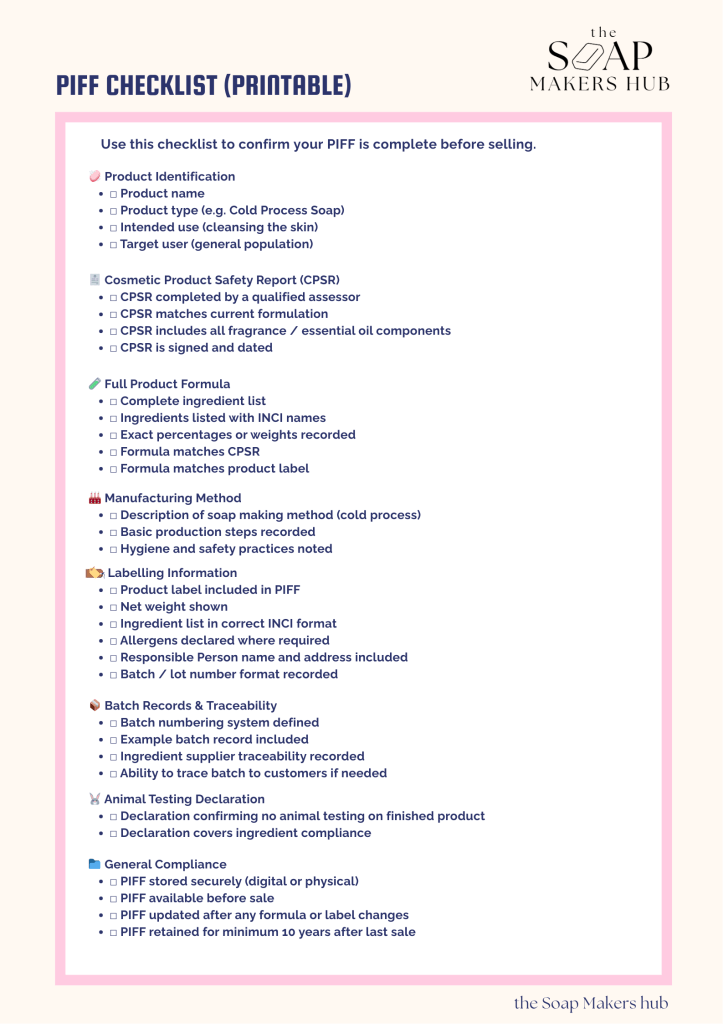
Download our Free Printable PIFF Checklist Here
Coming Up Next
We’ll explore:
Building PIFF templates that scale
How to prepare for a CPSR
Common PIFF mistakes that delay selling


 The Soap Makers Hub®
Leave a comment