How formulation choices work together to create a well-performing soap
As soap makers gain experience, the focus naturally shifts from individual ingredients to overall performance.
A well-performing bar is not defined by a single oil, additive, or technique. Instead, it is the result of thoughtful formulation decisions working together to create balance.
Designing a balanced bar means considering how hardness, lather, cleansing ability, longevity, and skin comfort interact — and adjusting your formulation with intent.
What Does “Balanced” Really Mean?
A balanced soap is one that performs reliably and comfortably in everyday use.
This typically includes:
✔ a firm, long-lasting bar
✔ satisfying, stable lather
✔ effective cleansing without harshness
✔ comfortable skin feel after rinsing
✔ durability during storage and use
Balance is not about maximising one quality. It is about achieving harmony between them.
The Role of Fatty Acid Balance
Fatty acids form the structural foundation of soap performance.
A balanced formulation typically includes:
Cleansing & bubbly lather
(from lauric & myristic acids)
Hardness & creamy lather
(from palmitic & stearic acids)
Conditioning & mildness
(from oleic acid)
Lather stability
(from ricinoleic acid)
Rather than focusing on specific oils, balanced formulation considers the fatty acid profile created by those oils.
Cleansing vs Comfort
Soap must cleanse effectively, but excessive cleansing strength can leave skin feeling tight or dry.
Balancing cleansing fatty acids with conditioning and stabilising components helps ensure:
- effective washing
- comfortable skin feel
- suitability for regular use
More cleansing power does not necessarily create a better bar.
Superfatting as a Refinement Tool
Superfatting contributes to skin comfort by leaving a small portion of oils unsaponified.
Used intentionally, it helps:
- soften the cleansing experience
- improve post-wash comfort
- refine overall feel
Superfatting supports balance, but it cannot compensate for an imbalanced formulation.
Lather: Quality Over Quantity
Consumers often associate large bubbles with performance, but lather quality matters more than volume.
A balanced bar produces:
- stable foam
- creamy texture
- satisfying rinse feel
Combining bubbly and creamy lather contributors creates a more pleasant washing experience.
Hardness and Longevity
Bar longevity affects both user experience and perceived value.
Hardness is influenced by:
- fatty acid composition
- cure time
- water content
- storage conditions
A well-balanced bar resists softening and dissolving quickly during use.
Skin Feel After Rinsing
One of the clearest indicators of a balanced soap is how the skin feels after washing.
Well-formulated soap leaves skin feeling:
- clean
- comfortable
- refreshed
rather than tight, dry, or coated.
This outcome reflects formulation balance rather than added luxury ingredients.
Climate, Usage, and Formulation Adjustments
Balanced formulation is not one-size-fits-all.
Soap makers may adjust formulations based on:
- humid vs dry climates
- frequent handwashing needs
- seasonal skin changes
- storage environments
Understanding balance allows you to adapt with confidence.
Recognising Imbalance
Soap that feels overly drying, dissolves quickly, lacks lather stability, or leaves residue may indicate formulation imbalance rather than ingredient quality.
Troubleshooting begins by evaluating fatty acid balance, superfat level, and overall formulation structure.
Bringing It All Together
A balanced bar is the result of thoughtful formulation rather than chance.
When fatty acid composition, superfatting, lather structure, and curing practices work together, the soap performs reliably and comfortably.
Designing with balance in mind transforms soapmaking from experimentation into intentional craft.
Final Thoughts
Balance in soapmaking is achieved through understanding rather than excess.
It comes from recognising how formulation elements interact and refining them with purpose.
As your knowledge deepens, you may find yourself simplifying rather than adding — adjusting structure rather than increasing complexity.
A well-balanced bar does not try to do everything.
It performs exactly as it should.
✅ Quick Soap Diagnostic Checklist
“Why isn’t my soap performing as expected?” use our checklist to help diagnose what’s going wrong with your Soap
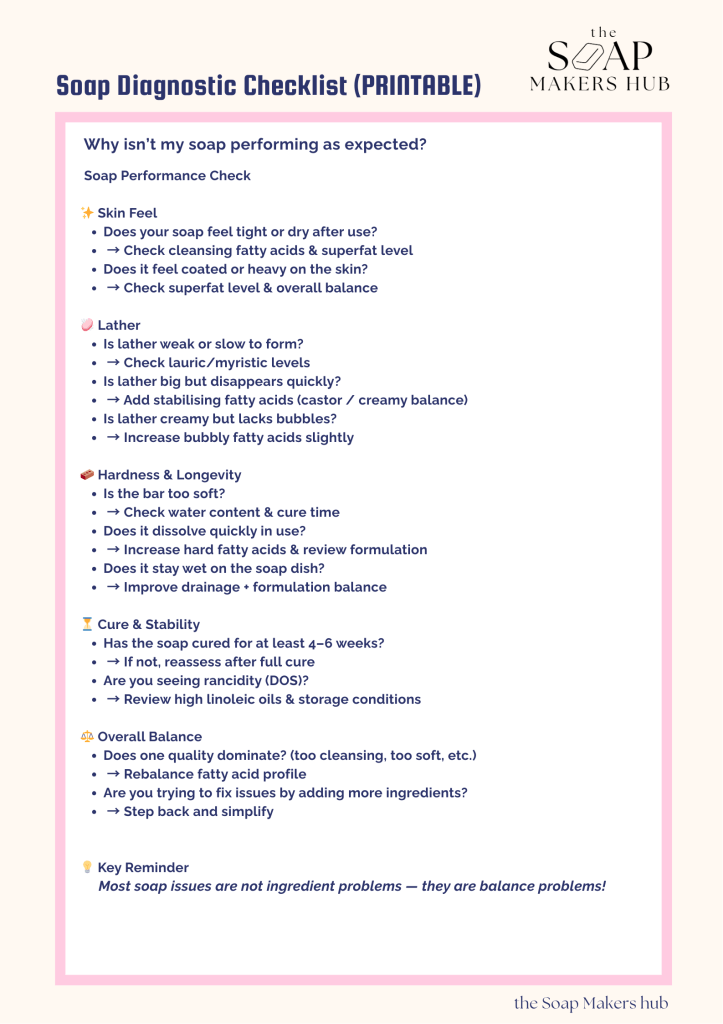
Download our Soap Diagnostic Checklist free Here
Continue Your Formulation Journey
→ Fatty Acid Profiles Explained Simply
Understand the structural building blocks of soap performance.
→ Superfatting With Purpose
Learn how intentional superfatting supports comfort and balance.
→ Retention of Naturally Occuring Glycerin
Discover how true soap naturally supports skin comfort.
→ Full Control Over Ingredients
Understand why intentional ingredient selection matters.



 The Soap Makers Hub®
Leave a comment